
Custom Zip-Up Hoodie Quotes: Compare a 100-Piece Run

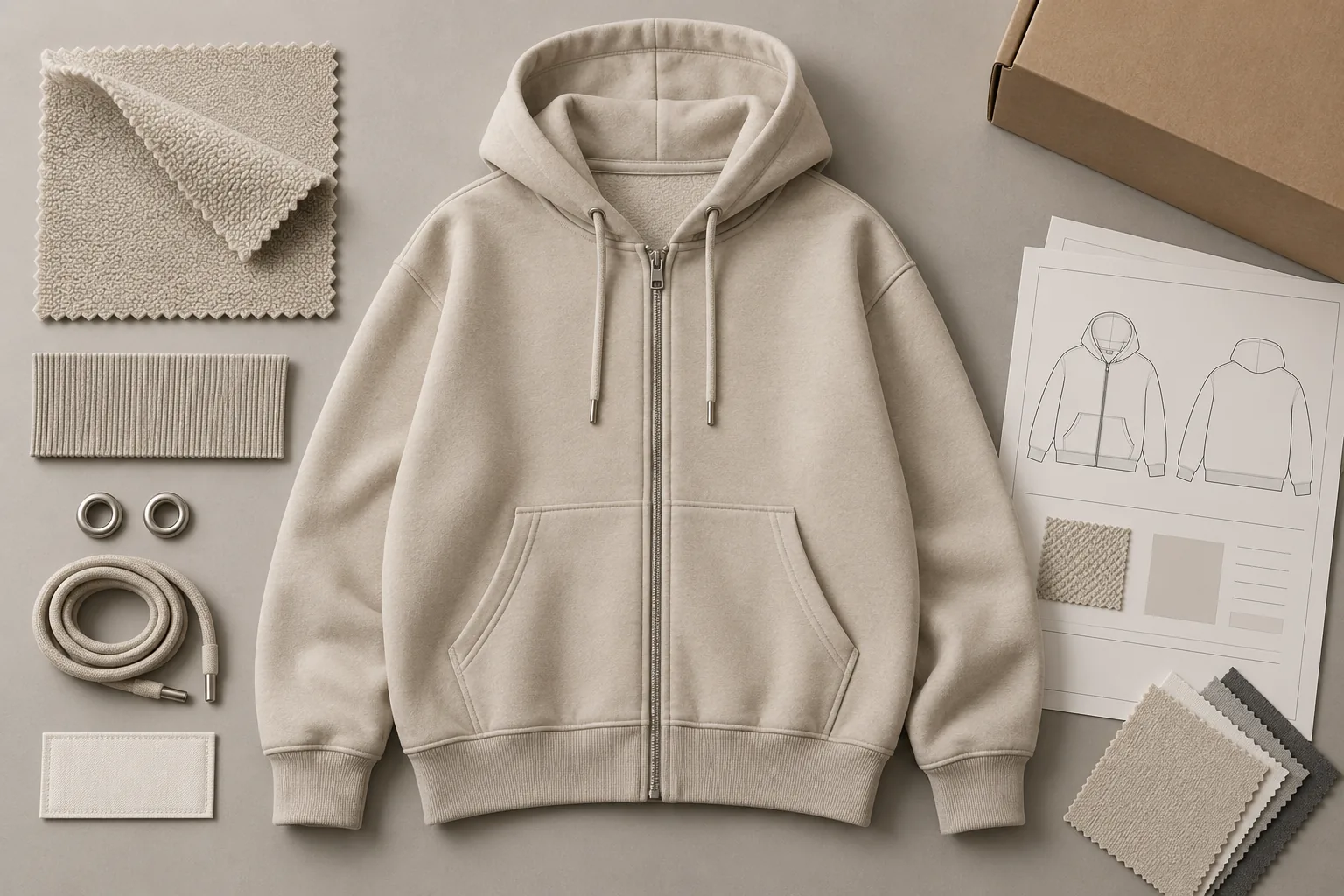
To compare custom zip-up hoodie quotes for a 100-piece run, give every supplier the same fabric, fit, hardware, artwork, size breakdown and delivery brief. Separate development fees from bulk unit pricing, list exclusions, and compare the total budget to the same destination. A lower headline price is useful only when the deliverables match.
A public streetwear buyer request makes the problem concrete: a heavyweight custom zip hoodie, prepared tech pack, graphics and branding, sizes XS–XXL, and an initial 50-unit plan that could rise to 100 depending on price. This is an individual procurement question, not a market-wide order statistic. It illustrates why first-drop buyers need a specification-led comparison.
Use search interest to refine the sourcing brief
A Google Trends check on October 10, 2026 compared the English search terms “custom hoodies” and “clothing manufacturer” worldwide and in the United States, United Kingdom and Germany, over 12 months and 90 days. The UK 90-day related-query lists included “custom zip up hoodies” and “low moq clothing manufacturer,” making customization and minimum quantities useful questions for this buying brief. These broader search terms do not measure demand for a 100-piece zip-up order or prove a buyer’s budget. Trends indices are relative to each comparison; do not compare separately normalized windows as absolute volumes or use unrelated queries as apparel evidence.
Check whether 100 pieces means one style and color
Write the quantity as a matrix: style, color, size and units. A total of 100 split between two colors may not meet a supplier’s minimum per color. Confirm whether different graphic versions, hardware finishes or material choices create separate production groups.
STX’s custom hoodie manufacturing page states a standard minimum of 100 pieces per style and color, with project review for materials and finishes. That is a starting condition, not confirmation that every 100-piece specification is feasible.
If you cannot support that quantity, compare a suitable existing blank with local decoration as an alternative. The tradeoff is less control over fit, fabric and construction. Do not increase inventory merely to obtain a lower unit price; calculate the total cash commitment and consider your own credible sales plan.
Fix the specification for custom zip-up hoodie quotes
“Premium heavyweight cotton” leaves too much open. Identify the fiber composition, finished GSM target, loopback or brushed construction, color reference and finishing process. Also define whether hood lining, rib and pocket bags use different materials.
STX’s fabric development resource provides relevant terry and fleece directions. Ask which proposed materials are available for your quantity and which require custom development. Approve a swatch rather than assuming two materials with the same weight have the same hand feel.
Specify the zipper type, length by size, tape color, slider and puller, opening configuration and hardware finish. If a named component is required, ask for its exact reference and availability. Do not assume a metal-looking zipper in a photograph establishes a brand or performance level.
For artwork, supply final dimensions, placements, colors and intended technique. A front graphic crossing the zipper requires separate alignment and process review. Request a technical recommendation before pricing an effect that may need redesign.
Request custom zip-up hoodie quotes with separate cost lines
| Quote line | Ask the supplier to state | Check before approval |
|---|---|---|
| Development | Pattern, prototype, grading and revisions | Deliverables, fees and credit conditions |
| Material | Composition, structure, weight and color | Available quantity and substitution rules |
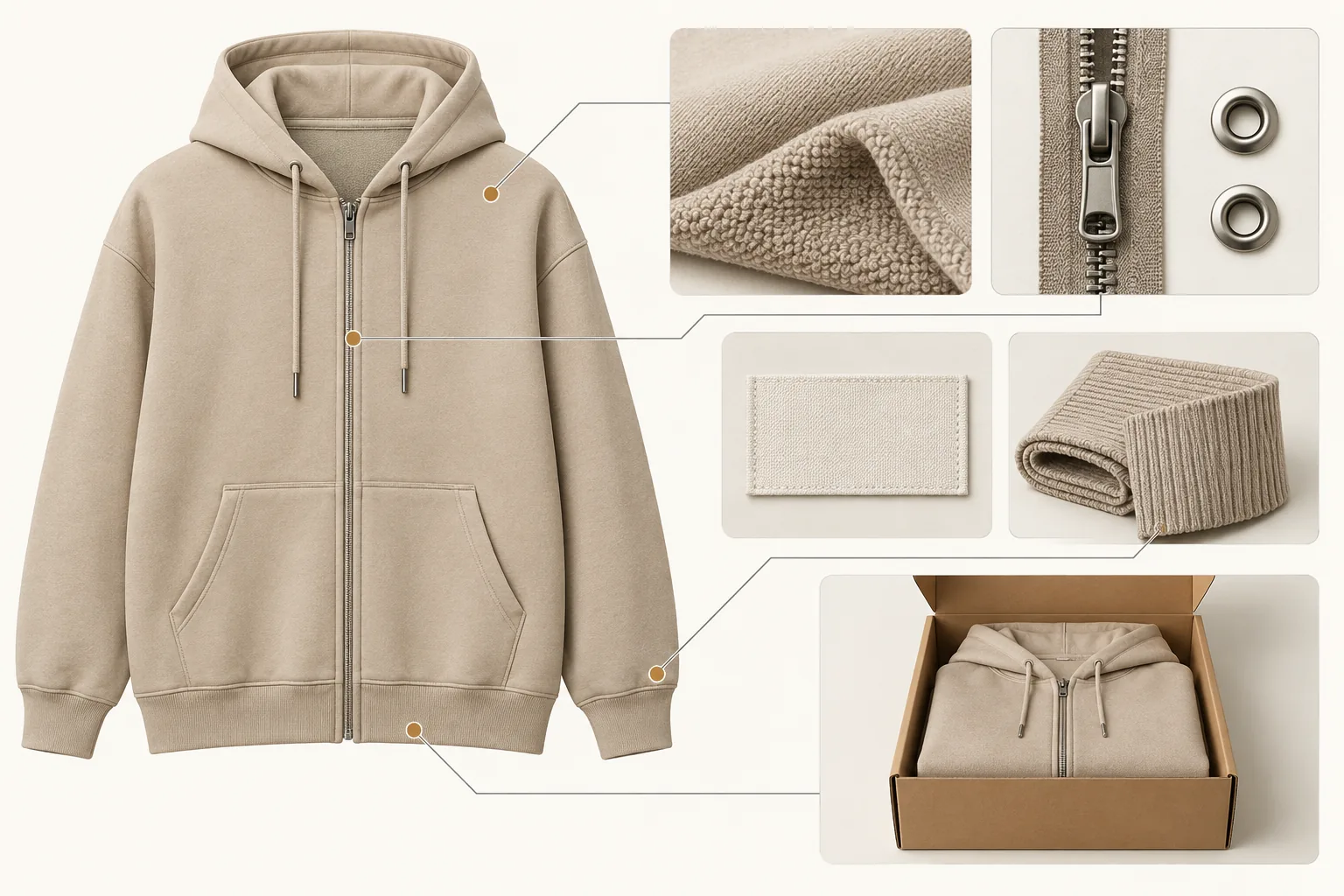
| Construction and trims | Zipper, rib, pockets, eyelets and cord | Exact references and size-dependent details |
| Decoration and branding | Artwork setup, application, labels and tags | Included placements and approval samples |
| Quality and packing | Inspection, testing and packaging scope | Acceptance criteria and excluded services |
| Delivery | Named destination, transport and trade term | Charges, validity and responsibilities |
Ask for assumptions as well as numbers. Is the price based on an approved sample, a substitute material, one artwork size across the range, or a provisional freight estimate? Keep quotation versions dated so changes can be traced.
CottonWorks’ garment construction guidance describes pattern engineering and markers used to arrange cutting pieces. This explains why the actual pattern and cutting plan matter. It does not provide a standard hoodie consumption figure or supplier margin.
Request confirmation that material usage accounts for the real size ratio, usable fabric width and any direction or matching constraints. A boxy silhouette, lined hood or added panel can change consumption. Avoid assigning a universal percentage of garment cost to fabric without project data.
Separate sample spending from the production budget
A prototype price pays for a different scope from a repeated production unit. Ask whether it includes pattern work, sourcing, artwork setup, trims, shipping and revisions. Confirm which later sample stages are charged separately and when development fees may be credited.
Use STX’s sample development support to discuss the required stages. A fit prototype can establish shape; approval of the final production material, hardware and decoration is a separate decision when substitutes were used earlier.
Evaluate savings through controlled alternatives. Request a second quote using an available fabric, a standard zipper finish or fewer decoration positions. Keep fit and quality requirements fixed where they are essential to the brand. Compare each revision against the same approval checklist.
Plan milestone dates with the supplier. STX publicly lists typical hoodie sampling of 7–10 days and bulk production of 30–45 days after sample approval and confirmation of materials and order details. Special development can extend those windows. Transport and import time need their own allowance; the published ranges are not a guaranteed arrival date.
Compare custom zip-up hoodie quotes on one delivery basis
Start with a budget ledger: development and sample transport, production, packing, any agreed independent inspection, freight, insurance where required, customs services and applicable import charges. Mark each item included, excluded or awaiting confirmation. Avoid counting the same freight or duty twice.
ICC’s Incoterms® 2020 guidance describes how the rules allocate costs, risks and obligations. Always record the rule, named place or port and edition rather than accepting “shipping included” as a complete delivery agreement.
The ICC 2024 checklist distinguishes maritime FOB from FCA options for other handover arrangements, including container or multimodal transport. It also recommends clarifying terminal, handling and customs charges. Review the appropriate arrangement with your forwarder and supplier. STX’s public discussion of FOB does not mean FOB suits every shipment or that other terms are automatically offered.
Ask your customs adviser to confirm classification, origin treatment and current destination charges for the actual garment. This comparison does not supply a duty rate. Keep unconfirmed amounts visible rather than converting a provisional delivered estimate into a firm landed-cost promise.
Make quality requirements part of the buying decision
Define acceptable measurements, zipper operation, pocket symmetry, print placement, shade variation and visible workmanship against the approved reference. Agree on the inspection scope, report and handling of nonconforming goods before the order, not after delivery.
Record how care behavior will be assessed. If dimensional-change testing is required, specify the applicable method, conditions and acceptance limits with the laboratory. Ask who pays for testing and any repeat assessment. A supplier’s willingness to make a sample is not evidence that the production garment has passed a particular test.
Frequently asked questions
Can I split 100 pieces across several colors?
Confirm the supplier’s quantity basis. STX states 100 pieces per style and color; a 100-piece total across multiple colors should not be treated as meeting that standard.
Is the cheapest unit price the cheapest launch?
Only if scope, quantity and delivery assumptions match. Add development, shipping and excluded services to compare the total commitment. Keep provisional items separate.
Can I reduce cost without changing the fit?
Ask about available fabric, standard hardware and simpler decoration. Approve any substitutions physically, because fabric and rib changes can still affect the silhouette.
Does a sample quote include pattern ownership?
Not automatically. Agree on file access, ownership, grading and revisions in the development scope. Treat sample transport and any fee credit as separate written terms.
Send a comparable request
For material or hardware feasibility questions, Contact STX Garment. For a priced proposal, Request a Quote with your tech pack, composition and GSM, color quantity matrix, size ratio, zipper specification, artwork, labels, packing, destination and target delivery date. Ask for itemized development costs, exclusions and a confirmed approval sequence.