
Boxy Hoodie Pattern Development: Fit Specs Before Bulk

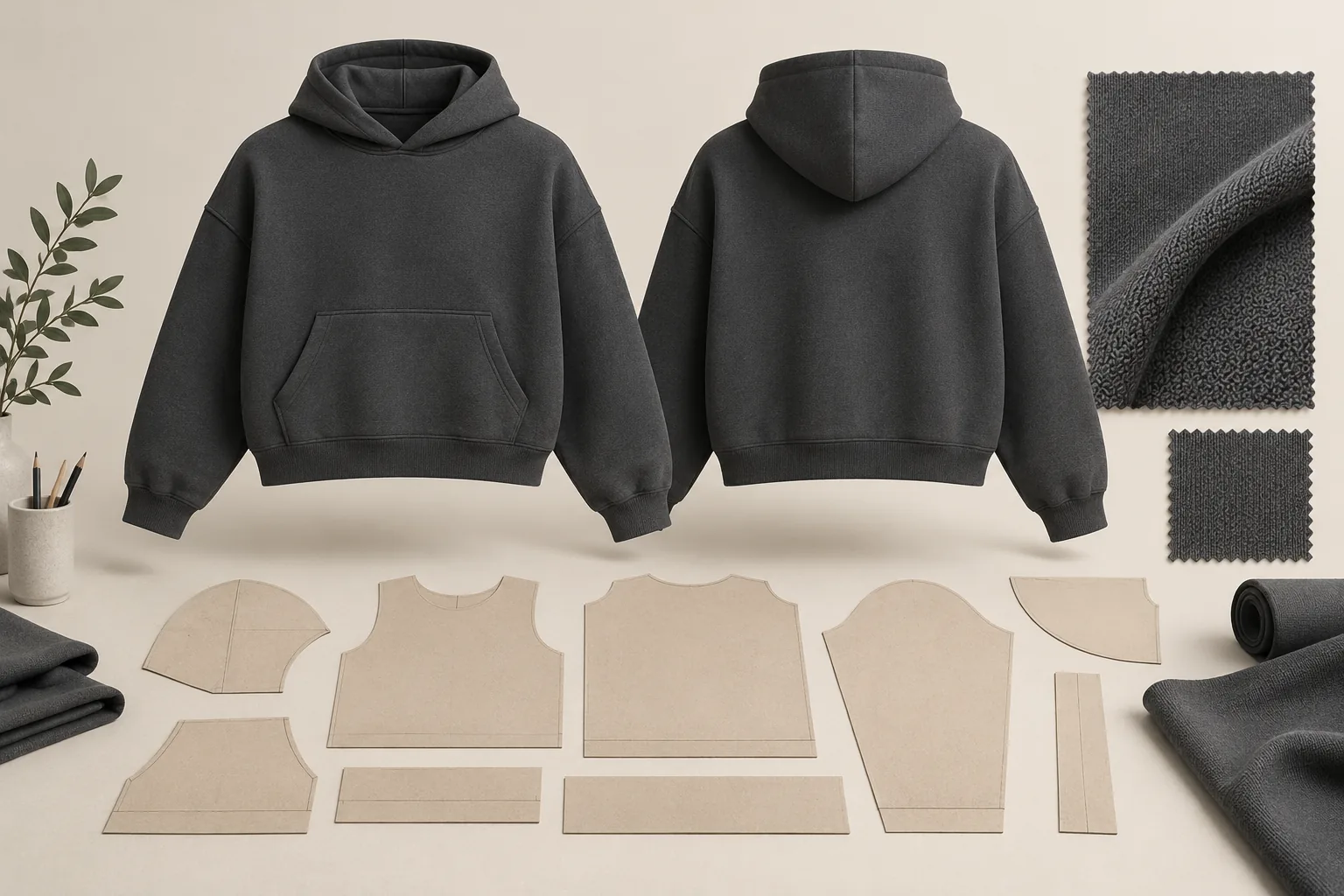
A boxy hoodie pattern needs a defined relationship between chest width, body length, shoulder position and sleeve shape. Start with a target wearer and an original measurement brief, choose the intended fabric, and approve the fit after the planned finishing and care process. Simply widening a standard hoodie does not control the complete silhouette.
This matters when a brand wants its own fit rather than a supplier’s existing blank. A public buyer discussion about custom pattern development describes that exact sourcing difficulty. It is one person’s problem, not evidence of global demand. For hoodie buyers facing a similar decision, the useful question is what the developer will deliver and how the fit will be approved.
Search interest is context for the fit brief
In a Google Trends comparison checked on October 10, 2026, the English search term “boxy hoodie” had lower average relative interest than “oversized hoodie” worldwide and in the United States, United Kingdom and Germany, in both the past 12 months and past 90 days. The worldwide 90-day related-query list included “boxy zip up hoodie” and “cropped hoodie.” These signals can help frame silhouette options for a brief; they do not establish wholesale demand, sales or a forecast. Indices are normalized within each comparison, so values from separate regions or time windows should not be treated as search volumes.
Define the boxy silhouette before asking for a pattern
Describe the garment on the wearer. Should the hem meet the waistband, sit above it, or extend below it? How much room is needed over a T-shirt? Should the shoulder drop be subtle or pronounced? Specify the intended size system and customer body range rather than treating “unisex” as a complete fit definition.
Use front, back and side sketches to show the proportions. Add an owned reference garment if available, noting what should change. Reference photographs can communicate direction, but perspective and styling make them unsuitable substitutes for measurements. Develop an original specification rather than copying another brand’s pattern.
Keep the first brief focused on a few priorities: body proportion, sleeve volume, hood shape and hem behavior. A wider chest with a shorter body may create the intended boxy effect; excessive sleeve length or a tight hem can change how that volume hangs.
Choose between a revised block and new development
Ask whether the proposed work adapts an existing block or develops a new style pattern. Neither route is automatically better. An existing block can be efficient when its armhole, neckline and balance already suit the project. New development may be appropriate when panel shapes, shoulder geometry or the intended silhouette differ substantially.
CottonWorks’ garment construction resource explains that basic blocks can be starting points for styled garments. That supports asking about the starting pattern; it does not establish any supplier’s ownership terms or development quality.
Agree in writing on the deliverables: base-size pattern, revision allowance, graded sizes, measurement chart and any digital files. Clarify ownership, reuse permissions and transfer arrangements separately. Do not assume paying a sample fee includes editable patterns or unlimited changes.
STX’s design support publicly describes pattern making and technical development. Its pattern and fit development capabilities include boxy and oversized directions. Confirm the scope, file handover and fees for your project before development begins.
Boxy hoodie pattern measurements that control the shape
Record each point of measure with a drawing, unit, measuring condition and agreed tolerance. Distinguish flat half-chest width from full circumference. Define exactly where body length begins and whether rib is included. Two charts can contain the same number while describing different measurements.
| Control point | Define in the brief | Review on the sample |
|---|---|---|
| Chest and body length | Measurement locations and hem inclusion | Overall width-to-length proportion |
| Shoulder and sleeve | Shoulder seam position; sleeve measuring path | Drop, reach and cuff position |
| Armhole and sleeve width | Depth and width locations | Movement and underarm bulk |
| Hood and neckline | Opening, depth and attachment shape | Coverage, balance and pull at the neck |
| Hem and cuff rib | Relaxed dimensions and attachment | Gathering, comfort and recovery |
A practical approval chart separates critical silhouette measurements from secondary construction checks. Set tolerances with the developer and inspection team after reviewing the material and sewing process. An arbitrary universal tolerance can be either unachievable or too loose for the intended fit.
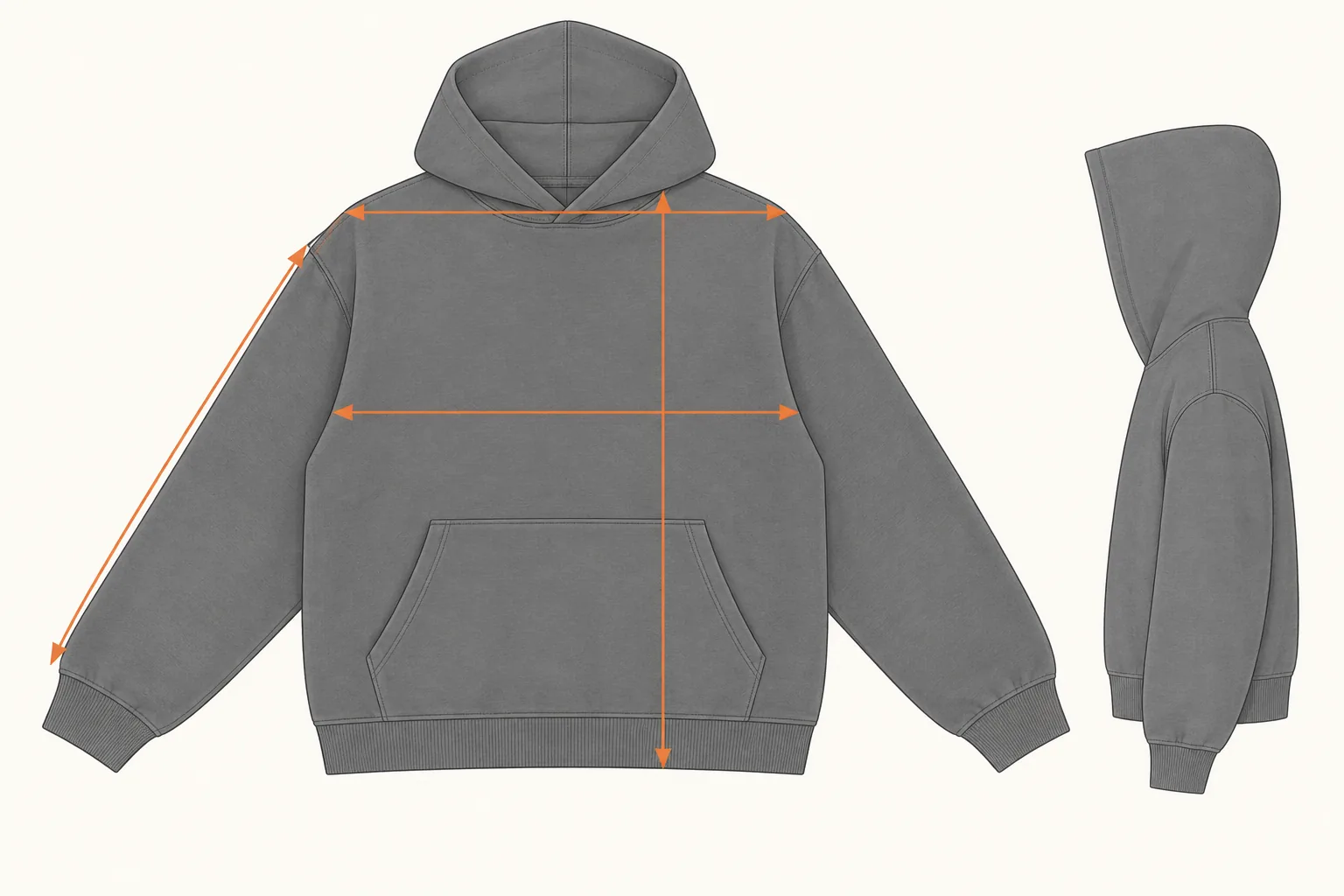
Develop the fabric and boxy hoodie pattern together
GSM describes mass per area; it does not fully specify drape, thickness or recovery. Review fiber composition, knit structure, finishing and rib alongside weight. A compact loopback material and a soft brushed fleece can produce different shapes from the same pattern.
CottonWorks’ shrinkage guidance identifies fiber, yarn, construction, processing and garment care as contributing variables. The manufacturing implication is to review dimensional behavior on the intended material rather than adding a generic shrinkage allowance to every pattern.
STX’s fabric development page lists French terry and brushed fleece among its options. Request swatches for the intended season, wearer and hand feel. Approve the chosen material before treating a fit sample in substitute fabric as a final reference.
Budget for the development route. Existing materials and a suitable base block may reduce sourcing and revision work. Custom colors, unusual rib or a special finish can add separate minimums and trials. Ask for those items separately so a change in fabric does not hide inside a revised sample price.
Approve your boxy hoodie pattern in stages
- Base-size review: measure the sample and assess it on the intended wearer over the planned underlayer. Photograph front, side and back in a neutral stance.
- Movement review: check arm reach, neckline pull, hood behavior and whether the hem rides up. Record each correction against a named measurement or pattern area.
- Care review: agree on laundering conditions, cycles, measurements and acceptance limits before testing. Assess appearance as well as dimensional change.
- Size review: inspect selected small and large sizes to confirm the silhouette remains intentional. Do not grade every measurement by one identical increment.
- Production approval: lock the material, pattern version, chart, trims and finish against the approved reference.
AATCC TM150-2025 addresses garment dimensional change after home laundering. Its public scope is a summary, not the full procedure or a universal pass limit. Have the laboratory confirm the applicable method and report actual conditions and results. This article does not establish a tested STX performance claim.
Ask which sample stages are needed through STX’s sample development support. Preserve the dated correction sheet and approved sample so the production team has one consistent reference.
Frequently asked questions
Does custom pattern making require a completely new block?
No. A suitable block may be adapted, while a distinctive construction may justify new development. Ask what will change, how it will be assessed, and which files and revisions are included.
Can a photograph define a boxy fit?
It can communicate direction. It cannot reliably define dimensions, ease or grading. Combine references with a wearer profile, measurement chart and physical fit approval.
Should I approve the pattern before selecting fabric?
You can explore proportions early, but final approval should use the intended material and finish. Changing the knit or wash can change the silhouette and dimensional behavior.
How do I keep larger sizes boxy without making sleeves too long?
Set grading rules by measurement and review a size set. Chest, shoulder, sleeve and body length need coordinated decisions rather than the same increase everywhere.
Prepare the development request
For questions about pattern feasibility or sample stages, Contact STX Garment. Once the design, material direction, quantity per color, size range and destination are defined, Submit Your Tech Pack for a Quote. Include the measurement chart, reference changes, artwork, trims, approval requirements and target delivery date. Request confirmation of development scope and timing before committing.