French Terry vs Fleece Hoodies: Choose a Manufacturing Route

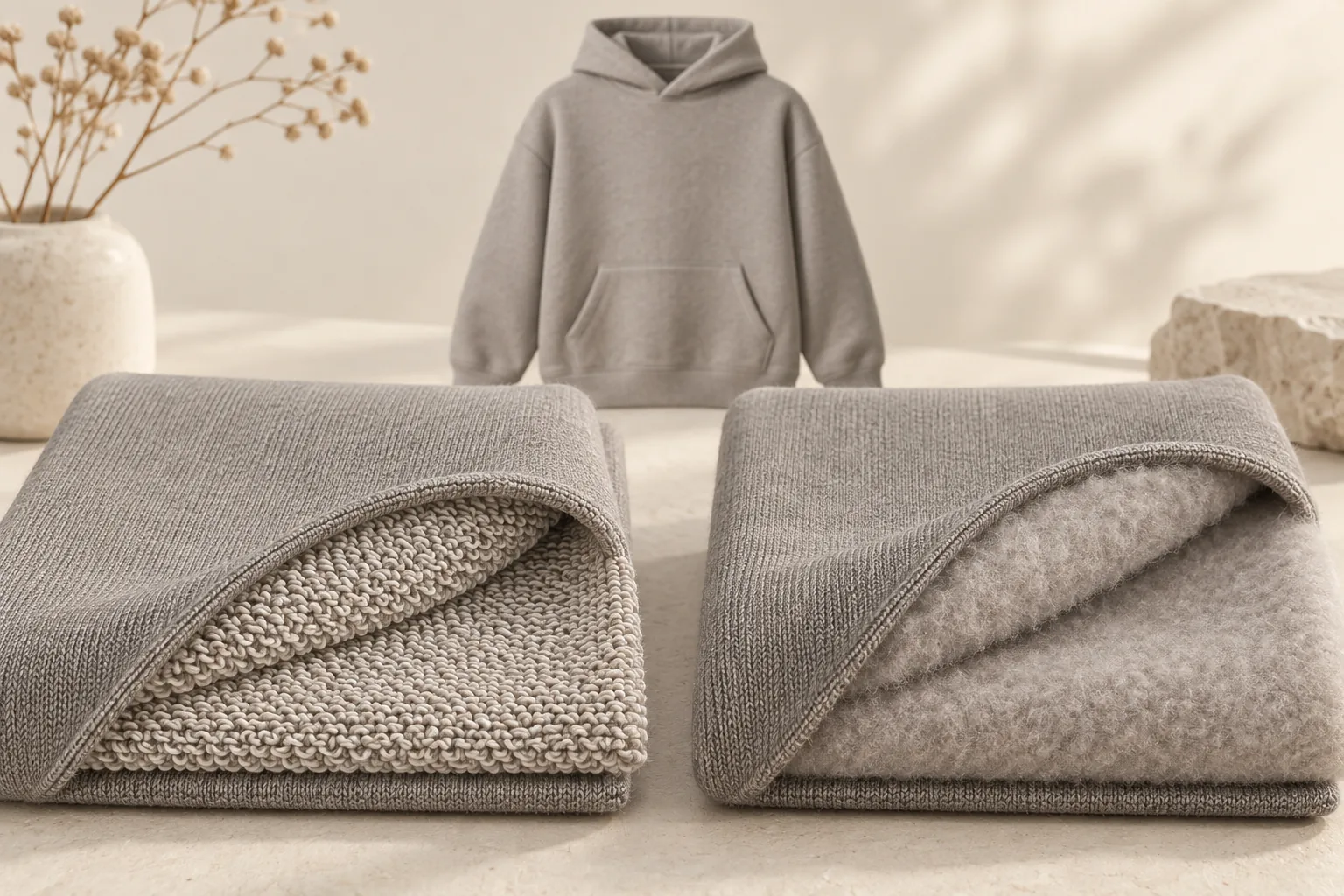
Choose French terry vs fleece hoodies by comparing the back surface, composition, finished weight and garment construction together. Start with loop-back terry when exposed loops suit the intended hand feel; start with brushed sweatshirt fleece when a plush interior is central to the brief. Validate comfort, bulk, fit and care on physical samples before committing to production.
This is a manufacturing choice with several variables. In a public hoodie development question, one first-drop founder compared a bulky cotton-poly fleece sample with a heavy cotton French terry sample and considered another blend. Their response was personal, not a market-wide quality judgment. It shows why changing weight, blend and construction at once makes comparisons difficult.
French terry vs fleece hoodies: structure and blend
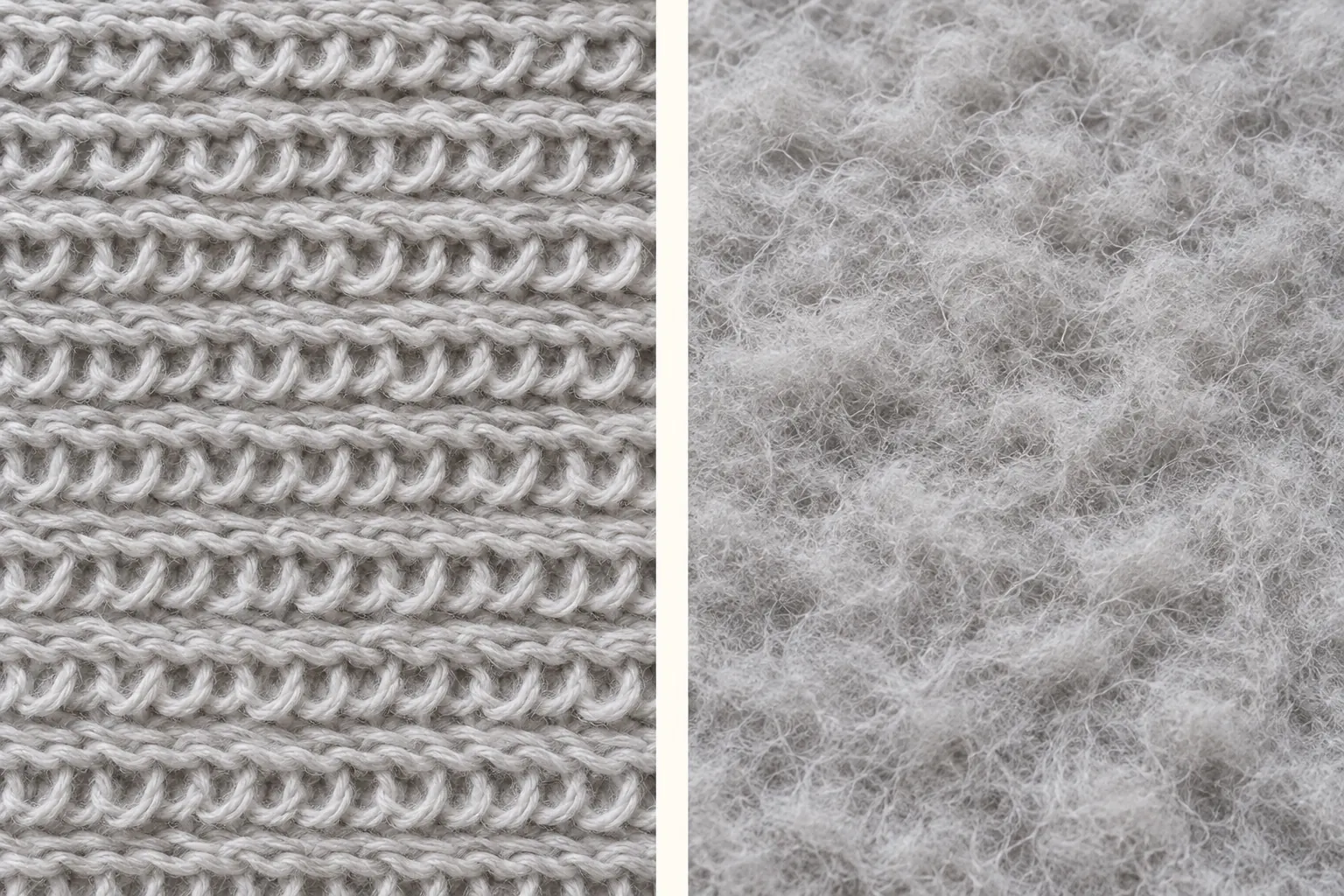
French terry describes a fabric structure and back-surface treatment, while cotton-poly describes composition. They are not opposing categories: a French terry can contain a blend, and a sweatshirt fleece can be cotton-rich.
CottonWorks’ knit construction guide distinguishes un-napped French terry from fleece whose back floats are napped. It also describes two-end and three-end fleece constructions. Ask the supplier to identify the offered structure and show both surfaces; a name on a quotation can leave important details unresolved.
CottonWorks’ mechanical finishing explanation describes napping as raising fibers to create a plush surface. The implication for sampling is that brushing intensity and surface finishing deserve their own approval reference. A fiber percentage alone cannot define that texture.
Compare French terry vs fleece hoodies on equal terms
Use a consistent base silhouette and review samples under the same wearing and care conditions. If one has a double hood and another has a single hood, the comparison includes construction as well as fabric. Record what changed so the next sample answers one clear question.
| Decision | Loop-back terry | Brushed sweatshirt fleece |
|---|---|---|
| Interior direction | Approve loop texture and skin feel | Approve raised pile and softness |
| Garment bulk | Check hood folds, seams and drape | Check pile plus layered construction |
| Composition | Confirm actual fiber blend | Confirm blend and face yarn information |
| Decoration | Trial the intended outer surface | Trial face surface and backing comfort |
| Care | Review dimensions and surface changes | Review dimensions, pile and visible lint |
These are review prompts, not guaranteed performance rankings. Neither construction name establishes a measured insulation value, pilling grade or shrinkage percentage. Define any claimed performance and ask what testing would substantiate it.
For a dense streetwear brief, request two or three relevant swatches rather than an unrestricted catalog. STX’s fabric development page publicly lists French terry and brushed fleece. Use that service to review stock options, finish and target cost, then confirm actual availability for your quantity.
Search interest for French terry vs fleece hoodies
A Google Trends comparison checked on October 12, 2026 used the literal search terms “french terry hoodie” and “fleece hoodie,” Worldwide, past 12 months, all categories and Web Search. The chart showed average relative indices of 1 and 20. A separate United States past-90-days comparison showed 1 and 43. Each chart is normalized independently: these are not search counts, sales or B2B order volumes, and the two charts cannot measure growth against each other. Use the wording as a discovery signal, then select materials through the sample brief.
Turn a seasonal idea into a material brief
“All season” needs a wearing scenario. Is the hoodie worn indoors over a tee, under outerwear, or as the main layer outside? Record the market, season, expected activity and desired hand feel. Countries contain different climates; a country name alone is not a comfort specification.
A public buyer planning roughly 50 hoodies asked for a cozy, all-season garment with a large chest graphic. That is a particular product brief. It does not establish global demand for terry or fleece, but it usefully connects comfort with artwork coverage and sourcing scale.
Ask the wearer to compare the candidates with the same base layer and record the result: too bulky at the neck, rough against skin, too warm indoors, or insufficient structure. Those observations guide development more clearly than “premium.” They remain sample feedback until the material specification and approval criteria are settled.
Use a brand specification as a reference, not a formula
The official UK AS Colour Heavy Hood 5146 listing specifies 400 GSM, 80% cotton/20% recycled polyester CVC fleece with a cotton facing, an oversized fit and self-fabric hood lining. This is a disclosed product configuration and a supply signal. It is not proof of sales volume or a universal recommendation for that blend.
Separate what you can learn from what you must develop yourself. Weight, face composition, hood layers and rib construction are useful briefing fields. Your own silhouette, fabric source, finish and decoration still require approval. Do not assume STX supplies that brand or can reproduce its garment from the listing.
French terry vs fleece hoodies: hood, rib and decoration
A heavyweight body with a fully doubled hood can feel different from the same body with a lighter lining. Check neck loading, hood stand, seam thickness and how the hood sits when down. Approve the construction with the chosen material; do not judge it only on a flat swatch.
Match cuffs and hem rib through recovery, hand feel, shade and care behavior. If the body and rib change differently after washing, the garment can distort even when each material looks acceptable alone. Record the exact rib reference instead of allowing an unspecified substitution.
Large artwork adds another variable. Confirm printable area, seams, pocket interference and desired surface feel before selecting the process. Use STX’s printing, embroidery and finishing options to discuss a trial on the selected face fabric. A sample establishes the approved combination; the technique name alone does not guarantee comfort or wash performance.
Choose a realistic sourcing and approval route
For a first run, compare an available stock fabric with custom development. Stock sourcing can simplify material development if the available color and finish suit the brief. Custom knitting, dyeing or finishing introduces separate minimums, approvals and scheduling variables. Ask for those constraints before selecting the route.
STX’s custom hoodie manufacturing page states a starting MOQ of 100 pieces per style and color, subject to project confirmation. A 50-piece buyer therefore needs a feasibility discussion, or an alternative such as suitable blanks and a decoration partner. Do not assume 100 pieces split across several colors meets the published condition.
Ask for separate sample and bulk scopes. Use a material approval, a complete garment review and a pre-production confirmation with a retained reference. If the supplier changes the fabric lot or finish, document whether a repeat trial is required. Budget for revisions, testing, labels, packing and transport as well as the garment price.
French terry vs fleece hoodies: material FAQ
Is cotton French terry always better than a blend?
No. Construction, yarns, finishing and the wearer brief all matter. Compare the actual candidates rather than treating a founder’s dislike of one sample as proof about every blend.
Does higher GSM make the hoodie warmer?
GSM states mass per area. It does not alone establish warmth, loft or comfort. Compare construction and garment layers, and obtain appropriate testing if making a thermal claim.
Should I request another sample after changing the hood lining?
Review the revised garment because neck feel, bulk and hood behavior may change. Approve the revised construction and update the specification before release.
What should I send when I only have a reference hoodie?
Describe what you like and dislike, identify composition where known, provide a size chart and specify quantities, colors, artwork and wearing scenario. A physical reference or swatch can support matching; confirm the resulting material rather than assuming an exact match.
Move from comparison to an order brief
For unresolved material choices, Contact STX Garment with your reference and sample concerns. Once the route is defined, Request a Quote with composition, construction, target GSM, finish, hood and rib details, sizes, quantities by color, artwork, acceptance requirements and destination. Confirm sampling and delivery milestones after technical review.